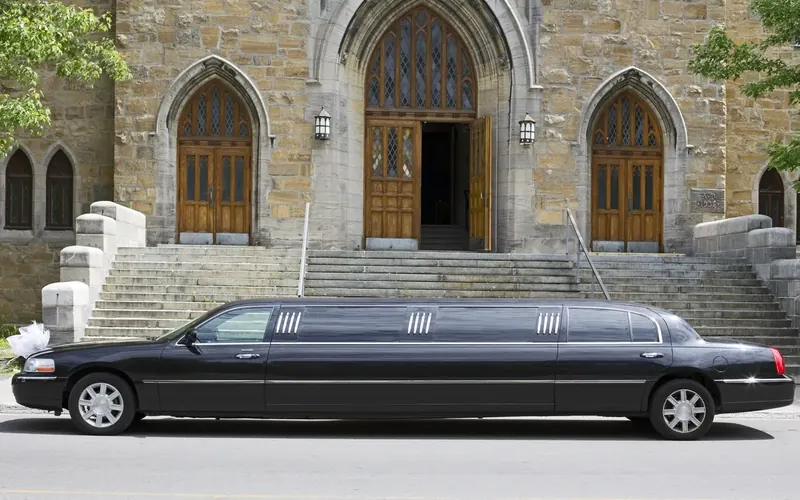
If you are asking how many hours to book a wedding limo, start with the trips rather than a round number: most couples need somewhere between four and eight hours, and the right figure depends on how many separate journeys one vehicle is making. Book for the hours you will actually use, from first pickup to final drop-off, rather than a number that leaves the car sitting idle. Here is how to count those hours before you commit.
This post walks through a simple way to add up your hours, what each part of the day usually takes, how Washington DC, Northern Virginia and Maryland traffic changes the math, and where couples commonly overbook or come up short. It is the practical companion to our complete guide to wedding transportation in Washington DC, which covers the wider planning picture.
Key takeaways
- Count hours from the first pickup to the last drop-off, not from the ceremony start
- One vehicle doing several trips usually needs more hours than two vehicles doing one trip each
- Add buffer for DC bridges, event days and photo stops, and write it into the run sheet
- Getaways and guest shuttles are priced on their own timelines, separate from the main car
The short answer on how many hours to book a wedding limo
For most weddings, the right number of hours falls between four and eight. That range is wide because it covers very different days: a simple courthouse elopement with one car may need only a couple of hours, while a full wedding with a church ceremony, a photo tour and a reception across town can easily run eight or more. The key is to count the hours you will actually use, not to pick a round number.
The biggest factor is how many separate trips one vehicle is making. A sedan that takes the couple from home to the ceremony and then to the reception might be booked for three hours. A stretch limo that picks up the bridal party, waits through photos, drives to the church, waits again, and then runs to the reception will need six or seven. Each stop adds time, and waiting time counts.
Another factor is whether you are booking one vehicle or several. When one car handles every leg for the couple, the hours add up quickly. When you split duties across a guest shuttle, a party bus and a getaway car, each vehicle may need fewer hours individually. Our wedding fleet includes vehicles for every size of group, so you can match the booking to the job rather than stretching one car too thin.
How to count your hours in four steps
Before you ask for a quote, sit down with your timeline and do a rough count. The method below takes about fifteen minutes and gives you a number you can compare against any company's minimum. You do not need exact minute-by-minute precision at this stage; you need a realistic total that includes the waiting you will actually do.
- List every trip the vehicle will make. Write down each separate leg: getting-ready pickup to the ceremony, ceremony to the photo location, photos to the reception, and the getaway at the end. Include any trips for the wedding party or parents if they are riding in the same vehicle.
- Time each leg door to door. Use a mapping app at the same time of day as your wedding to get a realistic drive time. Add five to ten minutes at each end for loading, unloading and the walk to the door, especially if anyone is wearing a long gown or a suit.
- Add buffer for the unknowns. Build in extra time for late arrivals, a ceremony that runs long, or a photo session that goes over. A common approach is to add fifteen to twenty minutes per major stop, and more if you are traveling during a known busy period.
- Add waiting time at each stop. If the vehicle is holding during your ceremony or photos, that time counts toward the booking. Decide whether you need the car to wait or whether it can leave and return; leaving and returning usually costs more hours overall than waiting.
- Total the legs and the waits. Add up all the drive times, the loading buffers and the waiting periods. That total is your working number. Round it up to the nearest half hour to be safe.
- Compare to the company's minimum. Most companies have a minimum booking, often three or four hours for a limo on a weekend. If your total is below the minimum, you will be charged for the minimum anyway, so consider whether you can use the extra time for photos or a relaxed drop-off.
- Check the total against your timeline. Walk through the day from first pickup to final drop-off and see if the number feels realistic. If you are unsure, ask the company to review your timeline; a good planner will spot gaps you might miss.
- Write the number into your quote request. Give the company your estimated hours and your timeline, and ask them to confirm whether the booking covers everything. A written quote should show the hours, the rate and any minimums so you can compare fairly.
Typical hours for each part of the wedding day
The table below gives rough ranges for common transport segments. These are not rules, just starting points based on typical weddings in the DC area. Your own numbers will depend on distances, traffic and how much waiting is involved.
Use the ranges to sanity-check your total. If your count is far outside these ranges, either you have an unusual plan or you have missed a leg. Either way, it is worth reviewing before you book.
| Segment | Typical hours | What affects it |
|---|---|---|
| Getting-ready pickup to ceremony | 1–2 | Distance, number of pickup stops, traffic |
| Ceremony waiting time | 1–2 | Length of ceremony, whether the car stays |
| Ceremony to photo location | 0.5–1.5 | Distance, loading time for the party |
| Photo tour | 1–3 | Number of stops, permit requirements, walking time |
| Photo location to reception | 0.5–1.5 | Distance, time of day, event traffic |
| Getaway car | 0.5–1 | Distance to hotel or after-party, late-night traffic |
| Guest shuttle (round trip) | 2–4 | Number of runs, hotel-to-venue distance, guest count |
Why one long booking often beats two short ones
It is tempting to book a car for the ceremony, release it, and book another for the reception. That can work, but it usually costs more in total hours and adds coordination risk. Two separate bookings mean two minimums, two sets of loading buffers and two chances for a timing gap. A single vehicle held for the full span often uses fewer total hours than two short bookings with a gap in between.
The trade-off is cost per hour versus convenience. A long booking keeps the same driver and vehicle with you all day, so your belongings stay in one place and your timeline does not depend on a second car arriving. It also means the car is waiting during your ceremony and photos, which you pay for but which removes the risk of a late return.
For couples who want to split the day, the better approach is often to use different vehicles for different jobs rather than splitting one car's hours. A guest shuttle can handle hotel-to-venue runs while a separate car handles the couple and the wedding party. That way each vehicle is booked for the hours it is actually needed, and you are not paying a limo to sit idle while a shuttle does the work. Our wedding transportation services are built around that kind of split, and we can help you decide which approach fits your day.
Where DC, Virginia and Maryland traffic adds time
Washington is a city of bridges and water, and that shapes wedding-day driving. The Theodore Roosevelt, Key, Memorial and 14th Street bridges all carry heavy weekend traffic, and one closure or drawbridge lift can add twenty minutes without warning. Downtown events, protests and road races close streets on short notice, so a route that works on a Tuesday may not work on a Saturday.
The Beltway and the radial highways into Virginia and Maryland are the other variable. I-66, I-395, I-495 and the Dulles Toll Road can back up for miles when a crash or lane closure hits. Venues along the Dulles corridor, in Loudoun County and around National Harbor sit far enough out that a single incident changes the schedule.
Venue driveways deserve their own line. Estates, churches and hotels here often have one narrow entrance, a gatehouse, or a shared lot with another event, and a bus or stretch limo takes longer to load and unload than a car. If your ceremony and reception are at different sites, count the full loop, not just the drive.
Photo tours, church legs and guest shuttles
Some parts of the day stretch a booking more than others. These are the segments couples most often underestimate, and each one is worth pricing as its own block of time rather than squeezing into a gap.
Photo tours that roam
A photo tour is not one stop. Couples often want the monuments, a neighborhood street, a park and a venue exterior, and each move between them costs loading time plus the drive. A tour that looks like an hour on paper can take two or three once you add walking, setup and the return. Book the wedding photo tour as a defined block with a start and end point.
Church legs and the gap after
A church ceremony adds a leg before and a leg after, and many churches ask the car to leave the entrance clear between services. That means the vehicle may need to circle or park nearby, which still counts against your hours. If the reception is across the region, the gap between the recessional and the last guest out of the pews is real time. See church wedding transportation for how these legs are planned.
Guest shuttles that loop
A shuttle is not a single trip. Hotel-to-venue runs repeat, and each loop includes loading, the drive, unloading and the return, so a shuttle booked for a two-hour window may only complete a few cycles. If guests are spread across two hotels, the loop grows. Plan the wedding guest shuttle around the number of cycles you need, not just the clock time.
The hotel-to-venue run
Getting the wedding party from a hotel to the venue sounds simple until you count the elevator wait, the bag drop and the walk to the car. Downtown hotels with one loading zone can take ten minutes per vehicle. A hotel to venue shuttle booked too tight leaves the first guests waiting and the last ones rushed.
Getaway cars that wait
The getaway car is often booked for a short window at the end of the night, but it still needs to arrive early enough to be in place. If the send-off runs late, the car waits, and that wait is billable time. Treat the getaway car as a block that starts before the exit and ends after the last photo.
Multi-vehicle days
When one car takes the couple, another takes the party and a third handles parents, the hours multiply. Each vehicle has its own first pickup and final drop-off, and a delay on one leg can ripple to the others. A multi-vehicle wedding plan works best when every vehicle's hours are written out separately rather than assumed to match.
Signs you have booked too few hours
Too few hours rarely announce themselves in advance. They show up as a rushed exit, a missed photo stop or a planner watching the clock instead of the couple. If any of these sound familiar, add time before you sign.
- The vehicle is due to leave before the ceremony ends, forcing a quick recessional and no receiving line.
- Your photo tour has more than two stops but only one hour on the quote.
- The gap between ceremony and reception is tight and the drive crosses a bridge or the Beltway.
- Guests are staying at two hotels but the shuttle is booked for a single loop.
- The getaway car is scheduled to arrive after the send-off is planned to start.
- You have not counted loading time at a venue with one narrow driveway or a gatehouse.
- The run sheet has no buffer between the last photo and the reception entrance.
- Your planner has asked for a vehicle to stand by and the quote has no standby time.
Building your hours into the run sheet and quote
Once you have a realistic count, the next step is to put it in writing. We build one written run sheet for every wedding and share it with you or your planner, listing each pickup, drop-off and standby block against the clock. That document is where your hours become visible, so a gap or an overlong photo tour stands out before the day rather than during it.
Every quote is written and itemized before booking, showing vehicles, hours, gratuity, tolls, parking, décor requests and deposit and cancellation terms. Nothing is booked until you accept it, which gives you room to compare the hours you need against the hours you are paying for.
On the day, the chauffeur stays in touch with your planner or a named contact, so a delay on the road is communicated rather than discovered. That is easier when the hours were set with buffer in the first place. If you are ready to put your own count on paper, start with our wedding limo service in Washington DC and then get a free wedding quote with the hours you actually expect to use.