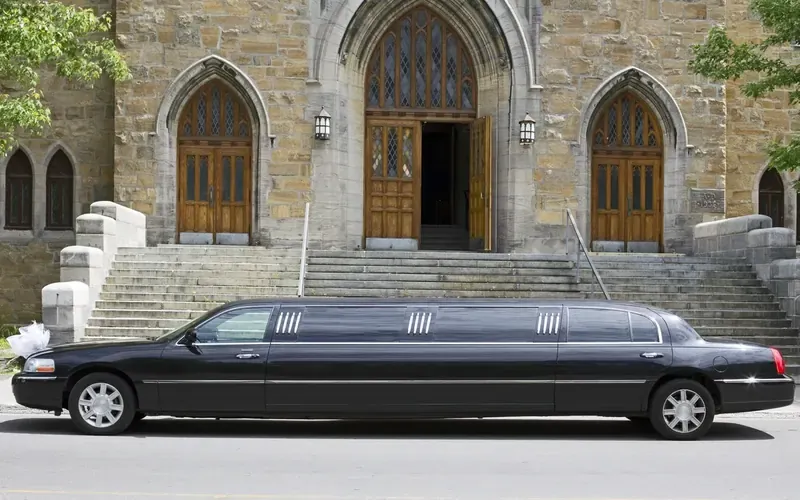
A wedding day transportation timeline is the hour-by-hour plan that puts every vehicle, chauffeur and passenger in the right place at the right time, from the first pickup to the last guest dropped back at the hotel. It answers the practical questions a ceremony schedule never does: who leaves when, in which car, with what in their hands, and what happens if the ceremony runs late. Get it right and the day feels calm. Get it wrong and the whole afternoon chases its own tail.
This post walks through how to build that timeline from scratch, starting with the fixed points you cannot move and working outward to pickups, photo stops and shuttles. You will find buffer rules, a sample schedule, a table for matching vehicles to jobs, and a free template you can copy into a document and share with your planner. If you are new to the subject, start with The Complete Guide to Wedding Transportation in Washington DC and come back here for the schedule itself.
Key takeaways
- Build the timeline around fixed points first: ceremony start, reception start and any hard venue cut-off.
- Give every leg a buffer that reflects real DC, Virginia and Maryland traffic, not a quiet Sunday morning.
- Write one run sheet and share it with your planner or a named contact who will carry it on the day.
- Match each job to the right vehicle size so nobody rides in a gown on a jump seat.
- Confirm the schedule in writing before the wedding week, then send a final version two days out.
Start With the Fixed Points, Not the Cars
Before you think about vehicles, write down the three or four times that cannot move. The ceremony start is the first: everything before it counts backward from that moment, and everything after it counts forward. The reception start, the cocktail hour and any venue curfew or end-of-night deadline are the others. Put those on a blank page in order and you have the spine of the whole schedule.
Then ask each venue what time you are actually allowed to arrive, not just when the event begins. Churches often need the party inside and seated well before the processional, and hotels and estates frequently hold the next event against a hard exit time. Add those arrival and departure windows to your page. A ceremony at four o'clock is really a three-thirty arrival, a three-fifteen lineup and a two-forty-five departure from wherever you are getting ready.
Only once the fixed points are written down should you talk about cars, and even then the first question is how many people need to be somewhere, not which vehicle looks best in photos. The order matters because a schedule built around a car tends to bend the day to fit the booking. A schedule built around the ceremony keeps the ceremony where it belongs, at the center. If you want the wider context first, our complete guide to wedding transportation in Washington DC covers the decisions that sit around this timeline.
Map Every Leg of the Day
Each move from one place to another is a leg, and every leg needs a departure time, a pickup point, a passenger list and an arrival time. Write them as rows in a table or a simple list so nothing hides inside a paragraph. The legs below are the ones most Washington-area weddings need to account for, even if some end up cancelled.
- Getting-ready pickupsCollecting the couple or the wedding party from home, a hotel or a rental and delivering them to the getting-ready location.
- Getting-ready to first look or ceremonyThe first real run of the day, often with dresses, suit bags and a photographer riding along.
- Ceremony to photo tourMoving the couple and photographer to a park, monument or neighborhood for portraits while guests travel to the reception.
- Wedding party to the receptionDelivering the bridal party and couple to the venue in time for introductions or cocktail hour.
- Guest shuttle from hotel to venueThe first of the shuttle loops, timed so guests arrive before the ceremony or during cocktail hour.
- Venue to hotel return shuttleThe end-of-night loops that carry guests back, usually running in rotation rather than once.
- Getaway carA separate vehicle waiting out of sight to take the couple from the reception to their hotel or next stop.
- Vendor and family movesParents, grandparents and anyone with limited mobility who needs a quieter, earlier ride than the main party.
Buffer Rules That Hold Up in DC Traffic
Traffic in this region is not a single problem, so a single padding number will not cover it. A crossing of the Potomac or the Anacostia can add real time when a bridge is heavy, and downtown event days, protests and road closures near the Mall can change a route you have driven a hundred times. Build your buffers by leg, not by habit, and add more where a bridge or a tunnel sits between you and the venue.
School-year weekday afternoons and Friday evenings are the stretches where ordinary congestion is worst, and a Saturday in spring or fall can be busier than a weekday because of weddings, games and festivals all at once. If your route passes a stadium, a university or a major event venue, check what else is happening that day. When you cannot confirm, add time rather than hope.
Venue check-in is the buffer people forget. Churches often want the party staged and quiet before the processional, and reception venues frequently need a few minutes for photos at the entrance, a receiving line or a grand entrance lineup. Add a small arrival cushion to every leg that ends at a venue, and tell your chauffeur the name of the person who meets you at the door.
A workable rule is to pad each leg generously enough that a normal delay does not touch the ceremony, then keep one larger reserve before the ceremony itself. If the schedule only works when every light is green, it does not work. Write the padded times on the run sheet and let the unpadded times stay in your head.
Match Vehicles to Jobs
Once the legs are mapped, group passengers by who actually travels together. The couple, the full wedding party, parents and the guest shuttle are four different jobs, and one vehicle rarely does all four well. The table below pairs common timeline jobs with fleet vehicles and their typical seat ranges; the exact vehicle is confirmed on your written quote.
For anything outside the fleet, such as a Rolls-Royce, Bentley, vintage or electric car, availability is confirmed on request. Ask early if a specific car matters to you, and keep a fleet vehicle as the plan that holds the schedule together.
How to Build a Wedding Day Transportation Timeline, Line by Line
With the fixed points, the legs and the vehicle jobs in hand, write the timeline itself. Work backward from the ceremony for everything before it, and forward from the reception start for everything after. Each line should name a time, a place, who is riding and what happens next.
Give the couple and the wedding party separate lines if they are getting ready in different places, then write the run to the first look or ceremony and the arrival times you confirmed with the venue. Leave the ceremony as a single block.
After the ceremony, write the photo tour, the wedding party run to the reception and the guest shuttle loops in order, with the getaway car last. If two things happen at once, put them on separate lines.
Read the finished timeline out loud with your partner, then with your planner. Anything that sounds tight on paper will feel tighter on the day. This is also the moment to hand the schedule to the people who will run it, which is what our wedding day coordination service is built around.
The Template, and How to Fill It In
You do not need software. A spreadsheet with one row per leg and columns for departure time, pickup point, passengers, arrival time and notes will do, and it prints cleanly for the people who carry it. Keep a second tab for fixed points and venue arrival windows so you can check the timeline against them.
Fill it in this order: fixed points, then legs, then buffers, then vehicles. Start with vehicles and you will end up moving the ceremony to suit a booking.
Add a column for the named contact at each stop, one for what the chauffeur should do on arrival, and one for anything that must travel with the passengers, such as rings, gifts or a change of clothes. Add a final column for the person responsible for that line, because a timeline without owners is a wish list.
Share the finished version with every venue and vendor who touches a leg, and ask them to flag conflicts rather than fix them quietly. Change the plan in one place and send the new version out with a date on it.
What the Run Sheet Does on the Day
On the day, the timeline becomes a run sheet: one written document shared with you or your planner, with the times, the stops and the names. Your chauffeur stays in touch with the planner or a named contact rather than chasing the couple during photos.
Build in a decision rule for the moments that go sideways. If the ceremony runs late, who decides whether the photo tour is shortened, and if traffic is heavy, who calls the venue? Write the answer next to the relevant line. Most timeline problems are really decision problems in disguise.
Keep the run sheet short enough to read at a glance, and keep the detailed version with the planner. A one-page version for the couple and a full version for the coordinator is a good split.
Common Timeline Mistakes to Avoid
The most common mistake is booking vehicles by the hour without knowing how many legs they cover. A car that sits idle between the ceremony and the reception still costs you those hours, so map the legs before you choose a booking window. Our guide to how many hours to book a wedding limo walks through that math.
The second is treating the guest shuttle as a single trip. Shuttles usually run in rotation, and the return loops at the end of the night take longer than the outbound ones because guests leave in waves.
The third is forgetting the people who move quietly. Parents, grandparents and guests with limited mobility often need an earlier, calmer ride than the main party. Give them their own line and, where it makes sense, their own vehicle.
The fourth is leaving the end of the night vague. Decide when the last shuttle leaves, where the getaway car is staged and who confirms the couple is away.
Where to Go From Here
Once your timeline is drafted, turn it into a written, itemized quote so you can see what each leg costs. Every quote we write lists the vehicles, hours, gratuity, tolls, parking, any décor requests and the deposit and cancellation terms before anything is booked. You can get a free wedding quote once your legs and passenger counts are settled.
If you are still early in planning, our month-by-month guide to when to book your wedding limo shows how this work fits the wider calendar.
A Sample Timeline for an Afternoon Wedding
Here is a realistic shape for a ceremony that starts in the middle of the afternoon, with the reception following at a separate venue. Treat the times as a pattern rather than a script, and shift each block to fit your own ceremony time, venue locations and how far apart your getting-ready spots are.
- Getting-ready pickupsThe bride's car and the groom's car arrive at their separate locations with time to spare, so the last hairpin and the boutonniere happen before anyone steps outside.
- Wedding party and family movesThe bridal party vehicle and the parents' sedan leave for the ceremony venue, aiming to arrive well before the first guests are seated.
- CeremonyThe couple arrives together or separately depending on the plan, and every vehicle waits nearby rather than leaving the area.
- Photo tourThe couple and a small group leave for nearby photo stops, with a hard return time written into the run sheet.
- Reception arrivalThe couple and wedding party pull up to the reception, and the guest shuttle begins its first loop from the hotel.
- Shuttle loopsThe shuttle runs a repeating circuit until the last guest who wants to come has arrived, then pauses until the end of the night.
- GetawayThe getaway car is staged and waiting before the send-off begins, so the couple leaves without a delay at the door.
- Final guest runThe shuttle makes its last trips back to the hotel, with the final departure time agreed in advance.
Who Holds the Run Sheet on the Day
A timeline only works if one person owns it. That is usually your planner or day-of coordinator, and sometimes a trusted family member if you are planning without one. Whoever it is should hold the current version, know how to reach each chauffeur, and be the single voice that confirms a change.
On the day, the chauffeur stays in touch with that named contact rather than with the couple. You will be in hair and makeup, then in a dress or a suit, then in the middle of a ceremony, and none of those are good moments to field a question about a pickup time.
Write the contact's name and mobile number onto the run sheet, with a backup name in case the first person is unreachable. We share the written run sheet with the couple or their planner before the wedding, and we confirm who the day-of contact will be. If you are still deciding how coordination will work, our page on wedding day coordination explains how the pieces fit together.
Build the Timeline in the Right Order
Build the schedule in this sequence and you will avoid the common trap of booking cars before you know what they need to do. Each card below depends on the one before it, so work down the list rather than jumping around.
Lock the fixed points first
Write down the times you cannot move: the ceremony start, the ceremony end, the reception start, the venue's access window and any hard curfew. Add the sunset time if you are planning photos outdoors, and the last shuttle time the venue allows. Everything else is built around these anchors, so get them exact and in writing before you plan a single pickup.
List every leg of the day
A leg is one movement from one place to another. Getting-ready location to ceremony, ceremony to photo stop, photo stop to reception, hotel to venue for guests, reception to hotel at the end. Write each as a separate line with a start point, an end point and who is on board. Most timelines miss a leg because it felt obvious, usually the one involving parents or the wedding party.
Add realistic travel times
Use the time it actually takes at the hour you will be driving, not the time it takes on a quiet Sunday morning. Cross-town routes in DC, the bridges into Virginia and the Beltway all behave differently at different times of day. Add a few minutes at each end for loading, unloading, photographs at the curb and finding the right entrance.
Apply your buffers
Put a buffer before the ceremony, before the reception arrival and before the last shuttle run. Buffers absorb a late hair appointment, a missing boutonniere or a photo stop that runs long. Keep them in the written schedule so nobody quietly removes them later.
Match vehicles to each job
Now that you know the legs, the passenger counts and the dress or luggage requirements, choose the vehicle for each one. A small group heading to photos does not need the same car as the whole wedding party, and guest shuttles need capacity rather than style. Our wedding fleet page lists the typical seat ranges for each vehicle type.
Confirm the details in writing
Check the pickup addresses, entrance names, contact numbers and any décor or red carpet requests against what is written on your quote. Anything you asked for that is not on the quote is not yet arranged. Read the cancellation and deposit terms too, so you know where you stand if plans change.
Share one final version
Send the finished run sheet to your planner or day-of contact, and confirm it is the version they will carry. Keep a copy on your phone and give a printed copy to whoever is helping family members on the day. After that, resist the urge to keep editing; one agreed version beats five slightly different ones.
Plan the Transportation With Your Quote in Hand
The timeline and the quote should describe the same day. Every vehicle, every hour, every pickup and every extra should appear on the written, itemized quote before you book, including gratuity, tolls, parking, any décor requests and the deposit and cancellation terms. If the schedule changes after you have the quote, ask for the quote to change with it.
That is also why we write the quote before anything is booked. You can see exactly what each vehicle is doing and for how long, compare it to your run sheet, and adjust before you commit. Our wedding transportation page covers the services the quote can include.
When you are ready, send us your fixed points, your list of legs and your rough passenger counts, and we will put together a written quote you can build the rest of the timeline around. You can request a free wedding quote at any point, and we will confirm the exact vehicle, hours and terms in writing before you decide.