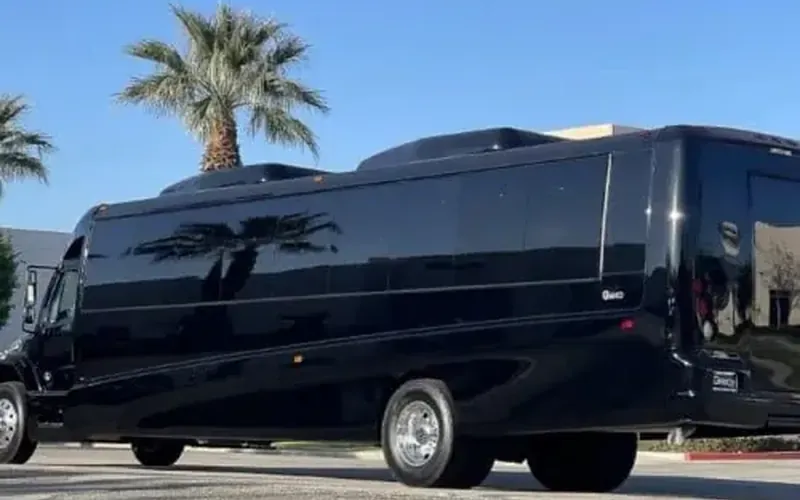
A wedding shuttle schedule and clear signage do more for your guests than the bus itself. If people do not know when the shuttle leaves, where it stops or when the last one returns, they will drive, call a car or leave early. This post shows you how to build a schedule that fits your ceremony and reception, and signage templates you can copy.
We run guest shuttles for weddings across Washington DC, Northern Virginia and Maryland, so we see which schedules work and which ones strand people at the curb. Below you will find how to set pickup times, what each sign should say, and how the plan gets written down and shared. If you are still deciding whether guests need transport at all, start with our guide to whether you need to provide transportation for wedding guests before you build the timetable.
Key takeaways
- Work backward from your ceremony start time, then add a buffer for DC traffic and hotel loading.
- Every pickup point needs a named sign, a posted departure time and someone who knows the plan.
- Write the schedule once and share it with your planner, the hotel and the shuttle driver.
- Signs should say the route, the departure time and the last return trip, nothing more.
- Book the shuttle early enough that the schedule you publish is the schedule you keep.
Start with the trips guests actually need
Before you sketch a single departure time, list the runs your day actually requires. Most weddings need three or four: hotel to ceremony, ceremony to reception, a return at the end of the night and sometimes a mid-evening trip for guests who leave early. Write each one down as a separate line with a start point and an end point. A run you cannot name is a run you cannot schedule.
Think about who is on each run, not just how many. Out-of-town guests at a hotel in Arlington heading to a ceremony in Georgetown are a different group from local family driving themselves to a reception in Loudoun County. If you are working through wedding guest shuttle planning for the first time, start with the people who have no other way to get there: guests without cars, older relatives and anyone staying near the venue.
The late return is the run couples forget. Guests who arrived by shuttle need a way back to the hotel after the dancing ends, and that trip usually needs its own departure time and its own sign. If your reception runs late, read our notes on getting guests home safely on late-night shuttles before you set the final time. Leave nothing implied: every run on your list should have a vehicle, a time and a person responsible for it.
Build the schedule backward from the ceremony
The ceremony start time is fixed, so build everything else backward from it. Work out the drive, add the time it takes to load a full bus, and set your departure earlier than feels necessary. The sample below shows how the pieces stack for a hotel-to-ceremony run.
- Ceremony startThe one time that cannot move. Every other time on the run sheet is calculated from this moment, so confirm it with your officiant and venue before you plan anything else.
- Arrival and seatingGuests need time to walk in, find a seat and settle before the processional. Aim to have the shuttle unload well before the ceremony begins rather than at the last minute.
- Travel timeUse a realistic drive for the day and hour, not an empty-road estimate. A route that takes minutes on a Sunday morning can take far longer on a Saturday afternoon in DC.
- Loading timeA full shuttle does not board instantly. Allow time for guests to gather, find the right bus and get seated, especially if older relatives need help with the steps.
- Call time at the hotelThis is when guests should be in the lobby, not when the bus leaves. Put the call time on the invitation and the sign so nobody is still in their room when the doors close.
- Chauffeur arrivalThe vehicle should be at the pickup point before the call time, so the bus is waiting for guests rather than the other way around. Confirm this on your written run sheet.
- BufferAdd a cushion to every leg for traffic, a late guest or a slow exit. The buffer is what keeps a single delay from pushing the whole day off schedule.
Timing table for a typical DC wedding day
The table below is a starting point, not a rule. Adjust the buffer for the day of the week, the route and the size of the group. A Saturday afternoon crossing into DC from Virginia needs more cushion than a short hop inside Northwest.
Note who rides each run. Parents and older guests often prefer a separate car with easier entry, while the wedding party may travel together. Your written quote and run sheet should show each vehicle and each leg clearly.
| Run | Who rides | Suggested buffer |
|---|---|---|
| Hotel to ceremony | Out-of-town guests and family staying at the hotel | Generous, with an early call time in the lobby |
| Ceremony to reception | All guests, especially where parking at the venue is limited | Moderate, plus loading time for a full bus |
| Photo tour or gap | Wedding party only | Moderate, planned around the photographer's route |
| Early evening return | Guests leaving after dinner or with young children | Moderate, with a sign at the exit |
| End-of-night return | Remaining guests heading back to the hotel | Generous, since guests leave in waves |
| Vendor and family car | Parents, grandparents and VIP guests | Light, but confirm pickup point in advance |
Wedding shuttle schedule and signage templates you can copy
A template saves you from starting with a blank page, but the details are what make it work. Copy the structure below into a document you share with your planner and your transportation company, then fill in the times from your own day. Keep one master schedule and one set of signs per run, and make sure the two match word for word.
The schedule template is a simple table: run name, pickup point, call time, departure time, arrival time, vehicle and contact. The sign template is a short block of text with the same run name, the same departure time and the same pickup point. If a guest reads the sign and calls the contact, that person should be looking at the same schedule you are.
Signs work best when they are printed large, mounted at eye level and placed where guests already are: the hotel lobby, the ceremony exit and the reception entrance. Put a second copy near the door guests will use at the end of the night, since that is when people are tired and least likely to read carefully. Laminate them if the event is outdoors, and bring tape or a stand so they stay put.
Your written run sheet is the version of the template that matters on the day. We prepare one for every wedding and share it with the couple or their planner, and the chauffeur stays in touch with the planner or a named contact as the day moves. That is how a schedule on paper becomes a schedule guests can actually follow.
- Event name and coupleA short line so guests know they are in the right place, especially at a hotel with several events that day.
- Run nameHotel to ceremony, reception to hotel, and so on. Name the direction, not just the destination.
- Departure timeThe time the vehicle leaves, stated plainly. Pair it with the lobby call time on a separate line.
- Pickup pointThe exact spot, such as the main entrance or the side door on the named street. Vague directions cause the most confusion.
- Vehicle descriptionThe type of vehicle and any identifying detail from your quote, so guests know what to look for at the curb.
- Contact name and numberThe planner or named contact who can answer questions on the day. One number, clearly printed.
- What to leave offSkip decoration, long welcome messages and anything that changes. A sign that is easy to read beats a sign that says everything.
What goes on each sign
A pickup sign has one job: help a guest who has never seen your schedule find the right vehicle at the right time. Keep it short and readable from a few feet away, and repeat the same facts in the same order on every run so guests learn the pattern.
- Event name and coupleA short line so guests know they are in the right place, especially at a hotel with several events that day.
- Run nameHotel to ceremony, reception to hotel, and so on. Name the direction, not just the destination.
- Departure timeThe time the vehicle leaves, stated plainly, paired with the lobby call time on a separate line.
- Pickup pointThe exact spot, such as the main entrance or the side door on the named street. Vague directions cause the most confusion.
- Vehicle descriptionThe type of vehicle and any identifying detail from your quote, so guests know what to look for at the curb.
- Contact name and numberThe planner or named contact who can answer questions on the day. One number, clearly printed.
- What to leave offSkip decoration, long welcome messages and anything that changes. A sign that is easy to read beats a sign that says everything.
Signage templates you can copy
Hotel lobby sign
Place this on an easel near the front desk or the elevator bank, where guests pass on the way out. Keep the wording to one screen of text: event name, pickup time, pickup door, return time. Guests read these in a hurry, so the times need to be the largest thing on the board.
Curbside sign at the pickup door
A second sign belongs at the actual door, not just in the lobby, because guests who step outside and see no bus will assume the shuttle is late. List the vehicle type and the departure time. The chauffeur can carry a matching card so guests can spot the right vehicle on a street with several buses.
Sign at the venue for the return trip
The return sign goes up before the reception starts, usually near the coat check or the exit the venue has assigned. State the first return departure, the last departure, and where the vehicle waits. Guests leaving early and guests staying to the end both need that one sign.
Welcome bag insert
A small printed card in the hotel welcome bag covers the whole weekend: shuttle times, pickup points, the last departure, and a phone number for questions. Many guests read this in their room the night before, so it should repeat the same times as the lobby sign. Keep one card per room.
Seat card inside the vehicle
A simple card on each seat, or one laminated sheet near the front, can show the route, the next stop and the return times. It answers the question guests ask most often mid-ride. Keep it short, and leave space for the contact name and number.
Digital version for the wedding website
Post the same wording on your wedding website and in any group message thread so guests can check it from their phones. Use the schedule wording from our guide to telling guests about wedding transportation so the printed and digital versions match. Consistency matters more than design.
Who holds the plan on the day
Every wedding guest shuttle we run comes with one written run sheet. It lists each trip, the pickup point, the departure time, the venue contact and the return times, and it is shared with you or your planner before the day. That single document is what everyone works from, so there is no second version floating around.
On the wedding day, the chauffeur stays in touch with your planner or a named contact by phone. If a pickup runs behind because the ceremony let out late or a guest is missing, the contact hears about it directly rather than from a frustrated guest in the lobby. Decide in advance who that person is, and make sure they are not also the bride, the groom or the person giving a toast.
Write the contact name and number on the run sheet and on the lobby sign. If your planner is handling the day, they hold it. If you are planning without one, a family member or a member of the wedding party who is not in the ceremony is a good choice. Give that person the authority to make small calls, such as holding a bus a few minutes or sending it on.
Adjusting for traffic, weather and late guests
Washington traffic is not uniform, and the bridges are where schedules break. A shuttle crossing the Potomac or the Anacostia during a weekday rush hour needs more buffer than the same trip on a Sunday morning. Build the buffer into the pickup time rather than the ceremony time, so guests arrive early and wait in the venue rather than arriving late.
Weather changes the walk from the hotel door to the curb. Rain, snow or summer heat can add several minutes to loading, especially for older guests and anyone in a long dress. Tell guests to be in the lobby a few minutes before departure, and plan the pickup point under a covered entrance where the hotel has one.
Late guests are the hardest part of any schedule. Set a clear policy in advance: the shuttle leaves at the posted time, and anyone who misses it is responsible for their own ride to the venue. Post the departure times prominently and have the chauffeur wait only briefly. For the trip home, our guide to late-night wedding shuttles covers how to handle the last run.
Planning the shuttle and getting a written quote
Once your draft schedule is settled, send it to us with the pickup points, the venue, the number of guests and the hours you need. We turn that into a written, itemized quote covering the vehicles, hours, gratuity, tolls, parking and any décor requests, along with the deposit and cancellation terms. Nothing is booked until you accept it.
The quote confirms the exact vehicle, which matters for a shuttle. A shuttle bus or mini coach seats up to 25 to 56 guests depending on the vehicle, so the seat count and the number of trips decide the plan. If your guest list grows or your timeline shifts, tell us before you sign so the quote reflects the real schedule.
When you are ready to move from a draft to a booked shuttle, request a free wedding quote and include your run sheet. We will confirm the plan in writing and share the final schedule with your planner or contact. From there, the signs, the times and the phone numbers all come from one document.