Fusion wedding logistics two ceremonies in one day work best when the planning is as careful as the vows. A tea ceremony with a Western ceremony or a Nigerian traditional wedding with a white wedding, the day succeeds on sequencing, guest movement and a written plan everyone can follow.
This post covers how to build a two-ceremony timeline that fits the venues, the families and the photographs, how to decide who travels in which vehicle, and where the pressure points usually appear. Transportation is only one part of the day, but on a double-ceremony schedule it is often the piece that holds the rest together.
Key takeaways
- Build the timeline around venue access, family customs and the longest drive of the day.
- Two ceremonies usually mean two different groups of people moving at different times.
- One written run sheet shared with your planner prevents most ceremony-day confusion.
- Match vehicles to the group: sedans for parents, larger cars for the bridal party, shuttles for guests.
- Confirm what each ceremony requires, from baraat space to church parking, well before the week of.
Why a fusion wedding needs a different kind of plan
Most weddings inherit a schedule. A church service has its own familiar order, a reception has its own rhythm, and everyone from the officiant to the photographer knows roughly how the hours run. A fusion wedding does not inherit anything. You are combining two sets of customs, often from two families with different expectations about what happens, in what order, and who is present for it.
Two ceremonies also mean two venue timelines. One space may be available to you in the morning and another only in the afternoon, or a single venue may need time to be reset between ceremonies. Add the customs that carry their own timing, such as a baraat procession or a tea ceremony with the elders, and the day becomes a schedule you build deliberately rather than one you follow.
The good news is that a built schedule is easier to defend. When every block of time is written down and shared, family members know when to gather, vendors know when to set up and reset, and your transportation is planned around real times instead of assumptions. For couples balancing two traditions, our guide to the Indian wedding baraat in DC shows how one ceremony's customs can sit inside a larger day without crowding it.
The timeline questions to settle first
Before you book anything, settle the handful of decisions that shape everything else. These are the questions that determine how many vehicles you need, how early the wedding party rises and whether your guests will be waiting or moving. Answer them with both families in the room, because the answers often involve customs one side assumes and the other has never heard of.
| Decision | Why it matters | Who to confirm with |
|---|---|---|
| Which ceremony comes first | Sets the whole day's order, including when the wedding party dresses and when photographs can happen | Both families and the officiants |
| Whether guests attend both ceremonies | Determines shuttle capacity, seating and whether guests need to travel between venues | Both families and your planner |
| Where the change of location happens | Decides drive times, buffer and where vehicles stage between ceremonies | Venue contacts on both sides |
| When the couple's photographs happen | Photo tours take time out of the schedule and may need their own vehicle and route | Your photographer and videographer |
| When the wedding party travels | The party often moves separately from parents and guests, which affects vehicle count | Wedding party and planner |
| How the venue resets between ceremonies | A reset can take longer than expected and may push the second ceremony start | Venue event manager |
| When food is served and to whom | Meals anchor the day and dictate when guests must be back in place | Caterer and venue |
| Who holds the schedule on the day | One named contact keeps vendors and drivers working from the same times | Planner or a family point person |
Moving people between venues
Drive times in this region are rarely the ones on a map. A route that looks short on paper can take much longer once you cross a bridge or enter downtown. The Theodore Roosevelt Bridge, the Key Bridge and the Woodrow Wilson Bridge all carry heavy weekend traffic, and a ceremony near the National Mall or Capitol Hill behaves very differently from one in Loudoun County or Annapolis.
Bridges matter most on a two-ceremony day because you cross them at fixed times. A morning ceremony in Virginia followed by an afternoon ceremony in DC puts you on a bridge in the middle of the day, and a reception run from Maryland into the District meets its own congestion. Build your timeline from realistic drive times, then add buffer, and treat the buffer as part of the plan rather than spare time.
Buffer matters more here than on a single-ceremony day because a delay does not just push one event. It compresses the gap between ceremonies, shortens the photo window and can leave guests standing outside a venue that is still being reset. When several vehicles are moving different groups, a written plan for each one keeps the day from depending on a single phone call, which is why multi-vehicle wedding transportation is worth planning as one coordinated schedule rather than separate bookings.
Who rides in which vehicle
A two-ceremony day usually means more people moving at more moments than a single ceremony does. Match each group to a vehicle by size and by what they need to do when they arrive, then write that assignment down so nobody negotiates it on the morning.
These are the groups most fusion weddings need to place. Your final vehicle list belongs on the written quote, and the exact car or bus is confirmed there.
The couple
The couple usually needs the most flexible vehicle of the day, because they move between ceremonies, photos and the reception. A stretch limousine suits a couple traveling alone, while a Sprinter limo van gives standing room and easy entry in a gown or a sherwani. If the couple changes outfits between ceremonies, build that stop into the schedule rather than squeezing it into a gap.
The bridal party
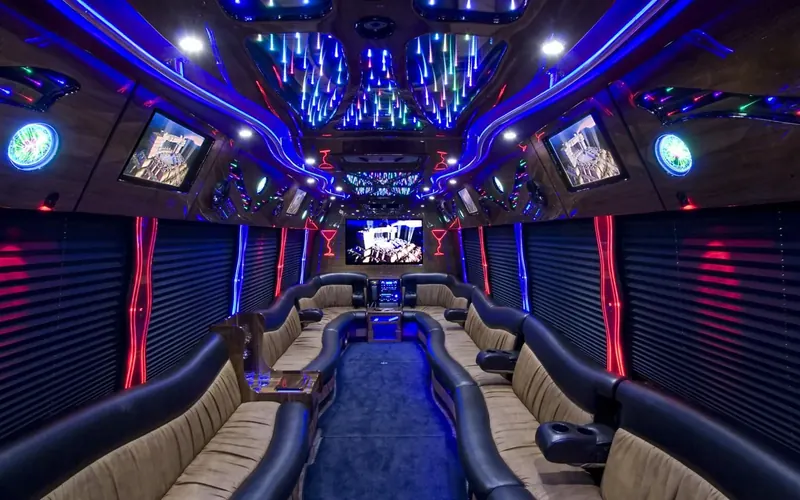
The wedding party often splits across the two ceremonies, with some members standing in both and others in one. An SUV stretch limo carries a full party in one car, which keeps everyone together for photos and the walk-in. A party bus works when the group is large or when the party includes cousins and close friends as well as attendants.
Parents and grandparents
Parents and grandparents often appear in both ceremonies and may need to arrive early or leave early. A luxury sedan or SUV keeps that group small, quiet and easy to load, and a single car can make several short trips if the venues are close. Give the chauffeur the names and phone numbers of the people in that car.
The baraat and the groom's side
If one ceremony includes a baraat, the groom's party needs its own plan for the procession and the arrival. Our guide to the Indian wedding baraat in DC covers the choice between horse, vintage car and limo, and how the procession ends at the venue. Confirm any horse, vintage or specialty vehicle on request, since those are not part of our regular fleet.
Guests staying at hotels
Out-of-town guests usually stay in one or two hotels, and those hotels become the pickup points for the day. A shuttle bus or mini coach can collect them for the first ceremony and return them after the second. Group guests by hotel rather than by family so the route stays short and the pickup times stay honest.
Planners and family coordinators
Someone needs to ride ahead or arrive first at each venue to check the room, the seating and the vendors. A sedan for the planner or a named family coordinator keeps that person free to move without asking the couple for a car. Put that person's name and number on the run sheet as the day's point of contact.
Putting the vehicles on one plan
Most fusion weddings need three or more vehicles working on different schedules, and that is normal. Our multi-vehicle wedding transportation page explains how the cars, hours and handoffs are written down together. Ask for one itemized quote covering every vehicle rather than separate quotes you have to reconcile yourself.
Guest shuttles and the second ceremony
A hotel-to-venue shuttle is the simplest way to move guests between two ceremonies without asking them to drive and park twice. The shuttle collects guests at the hotel, drops them at the first ceremony, waits or returns, then moves them to the second venue. For a fusion wedding, that pattern repeats, so the shuttle schedule has to be built around both ceremonies rather than one.
The pickup window is the detail that causes the most confusion. Guests hear a start time and drift down to the lobby over half an hour, which throws off the first drop-off and every stop after it. Write a pickup window with a clear start and end, name the lobby or entrance, and give the shuttle a departure time that does not wait for the last guest.
Between ceremonies, guests often have an hour or two to fill, and where they go matters. Some couples send everyone to the second venue for a social hour; others send them back to the hotel to change. Whichever you choose, the shuttle needs a written loop for that gap, and guests need to know when the next pickup leaves. Our hotel to venue shuttle page covers the pattern in more detail, and the wedding guest shuttle page covers capacity and loading.
The written run sheet and the day itself
Every wedding we handle gets one written run sheet, shared with the couple or the planner, and on the day the chauffeur stays in touch with the planner or a named contact. For two ceremonies, that sheet is the difference between a calm handoff and a day spent on the phone.
- First ceremony arrivalThe couple's car and the family cars arrive ahead of guests, with the bridal party close behind. The chauffeur confirms the contact is on site before the couple steps out.
- Procession and first ceremonyVehicles wait in a confirmed spot, not a loading zone that will be needed by the next arrival. The planner knows where each car is parked and how to reach the chauffeur.
- The transitionGuests move by shuttle, the couple moves by car, and the two schedules are written separately. The run sheet notes who leaves first and which entrance each group uses.
- Outfit change or quiet stopIf the couple changes between ceremonies, the stop is on the sheet with a start and end time. The chauffeur holds the car at the door rather than circling the block.
- Second ceremony arrivalThe couple arrives after guests are seated, and the family cars arrive early enough for photos. The second venue's contact is named on the sheet.
- Reception runThe couple's car leaves last and arrives at the reception after the room is ready. Guest shuttles make their final loop from the second venue to the hotel or reception.
- End of nightThe getaway car and any guest shuttles have written departure times. The chauffeur confirms the last pickup with the planner before leaving the venue.
Planning transportation for your fusion wedding
Start with the two ceremonies rather than with the vehicles. Write down the venues, the start times, the guest count at each, and the gap between them. That gives you the shape of the day, and the vehicle plan follows from it. If you are still choosing venues, our wedding venues we serve page lists the kinds of places we drive to across DC, Virginia and Maryland.
When you ask for a quote, ask for it in writing and itemized. It should list each vehicle, the hours it is booked, gratuity, tolls, parking, any décor requests such as red carpet or signs, and the deposit and cancellation terms. Nothing is booked until you accept it. If a specialty car, a horse or a vintage vehicle is part of your plan, say so early and treat availability as confirmed on request.
Before you sign, ask a few direct questions. Who is our contact on the day, and how does the chauffeur reach them? What happens if the first ceremony runs late? How is alcohol handled in the vehicles, given the ages of guests and DC, Virginia or Maryland law? The answers belong on the quote, and our wedding limo FAQs cover the ones couples ask most. When you are ready, get a free wedding quote and we will build the itemized plan around your two ceremonies.