Transportation planning for a large South Asian wedding is really a scheduling problem with a few hundred people in it. A mehndi, a sangeet, a baraat, a ceremony and a reception can spread across several days and several venues, and each event has its own crowd, its own start time and its own parking reality in Washington DC, Northern Virginia or Maryland.
This post walks through the events in order and shows how to move each group: the couple, the wedding party, parents and elders, out-of-town guests and the baraat itself. It covers vehicle choices by headcount, where the real bottlenecks show up, and how a written run sheet keeps a multi-day wedding from depending on group texts.
Key takeaways
- Count heads per event, not per wedding, and match each group to a vehicle size.
- Elders and out-of-town guests need door-to-door shuttles, not drop-offs blocks away.
- The baraat needs its own plan for the procession, parking and the arrival at the venue.
- One written run sheet shared with your planner beats a dozen separate group chats.
- Ask about alcohol and décor policies in writing before you book anything.
Why South Asian wedding transportation needs its own plan
Most weddings we drive involve one ceremony and one reception on the same day. A South Asian wedding often runs three or four days, with a mehndi at a family home or hall, a sangeet at a hotel ballroom, a baraat and ceremony at a temple or hotel, and a reception somewhere else entirely. Each event has a different guest count, a different start time and a different parking situation. The transportation has to be built event by event, not as one booking for one day.
The guest list adds its own pressure. A wedding of three hundred people means a large share of guests are flying in, staying in hotels across DC, Arlington, Tysons or Bethesda, and relying on someone else for rides. Family members arrive from out of town and want to help, but a cousin with a rental car cannot move forty people. The plan has to account for elders who need door-to-door service, relatives who do not know the area, and a wedding party that is getting ready in a different place from the couple.
There is also the question of who holds the plan. When transportation is spread across several days and several groups, details get lost between the couple, both sets of parents, the planner and the venue coordinators. That is why every wedding we handle gets one written run sheet, shared with the couple or their planner, that lists each pickup, each vehicle and each event. For a wedding with this many moving parts, the run sheet matters as much as the cars. If you want the wider picture of how we handle multi-day and multi-event weddings, start with our cultural wedding transportation page.
Matching vehicles to each group and headcount
The useful way to choose vehicles is to start from groups, not from cars. List every group that needs to move on its own schedule: the couple, the wedding party, parents and elders, the baraat group, and out-of-town guests. Then match a vehicle to each group's headcount and the kind of entry that group needs. A gown and a heavy lehenga both change how easy it is to get in and out of a vehicle, so standing room and door height matter as much as seat count.
The table below pairs typical groups with vehicles from our fleet and their usual seat ranges. Treat the ranges as a starting point: the exact vehicle and capacity are confirmed on your written quote, and a group at the top of a range will be more comfortable in the next size up.
| Group | Suggested vehicle | Typical seats |
|---|---|---|
| Couple only (getaway, photo tour) | Stretch Limousine or Luxury Sedan & SUV | Up to 8–10 (limo); up to 3–6 (sedan/SUV) |
| Small bridal party or close family | Escalade Limo | Up to 12–14 |
| Full wedding party in one car | SUV Stretch Limo | Up to 14–20 |
| Party with elders who need easy entry | Sprinter Limo Van | Up to 10–14 |
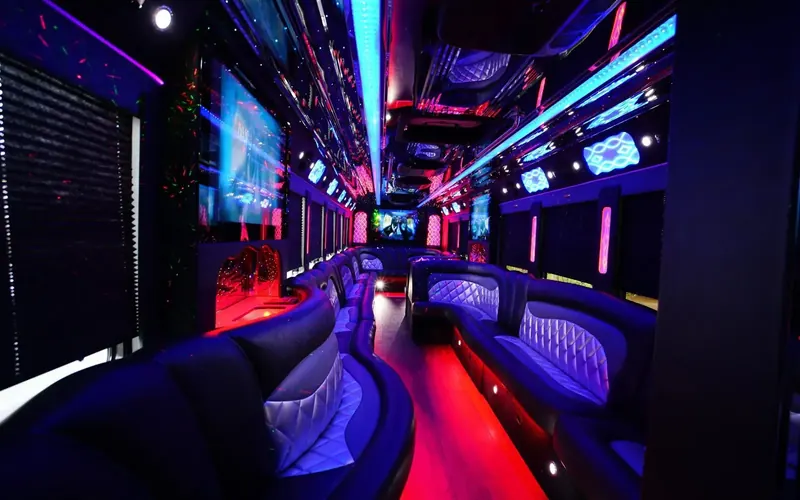
| Large party, photos and reception run | Wedding Party Bus | Up to 20–40 |
| Guest shuttles, hotel to venue | Shuttle Bus & Mini Coach | Up to 25–56 |
| Parents, grandparents and VIP guests | Luxury Sedan & SUV | Up to 3–6 |
Moving the couple and the wedding party between events
The couple's car and the wedding party vehicle should run on separate loops. The couple usually needs to leave early, arrive before guests, and sometimes stop for photos on the way. The party vehicle often leaves later, collects everyone from one or two getting-ready locations, and arrives closer to the ceremony. If both groups share one vehicle, the couple ends up waiting on the party or the party ends up waiting in the car while the couple takes photos.
A workable pattern is three loops. The couple's car handles the couple, the first look and any photo stops. The party vehicle runs the bridesmaids and groomsmen from the hotel or family home to the ceremony and then to photos. A third set of vehicles, often sedans or SUVs, moves parents and elders who want to arrive early and sit down before the crowd. Each loop has its own start time and its own named contact, and the run sheet shows where they meet.
Between events, the gap is where plans break. A sangeet that runs late, a ceremony that starts behind schedule, or a photo session that takes longer than expected all push the next pickup. Build buffer into each loop rather than assuming events end on time, and decide in advance which group has priority if two pickups collide. Your chauffeur stays in touch with the planner or a named contact on the day, so changes get relayed to the right vehicle instead of circulating through group texts.
Getting elders, family and out-of-town guests to the venue
Grandparents and older relatives are the group most likely to be left out of a transportation plan. They often stay with family rather than in a hotel, they may not want to ride in a party bus, and they need to be dropped at the door rather than in a distant lot. A sedan or SUV for parents and elders, with a pickup at their door and a drop at the venue entrance, solves most of this. Build in extra time for the walk from the car to their seats.
Out-of-town guests are a different problem. They are staying in hotels across the region, they do not know which roads back up on a Saturday afternoon, and many will not want to drive after a long reception. Door-to-door shuttles from the hotel to the venue and back are the simplest answer. Our wedding guest shuttle service is built for exactly this: a set departure from the hotel, a set return at the end of the night, and a driver who knows the route.
Hotel choice shapes the shuttle plan more than most couples expect. A hotel in Arlington or Tysons gives guests easy access to venues in Northern Virginia, while a hotel in downtown DC suits Capitol Hill, Georgetown and Wharf venues. Where guests are spread across several hotels, consider one or two pickup points rather than many stops, and tell guests the pickup time in the invitation or a details card. Our hotel to venue shuttle page covers how the route and timing come together.
The baraat: procession, parking and the arrival
The baraat is where transportation and celebration overlap. The groom arrives with family and friends, often with dhol, and the procession moves on foot for the last stretch to the venue. You need a drop point where the group can gather without blocking traffic, a place for the vehicles to wait, and a clear walking route to the ceremony space. Our guide to the Indian wedding baraat in DC compares the horse, vintage car and limo options in more detail.
Parking is where baraats go wrong in this region. A hotel driveway in downtown DC, a temple lot in the suburbs and a Virginia estate all handle a procession very differently. Ask the venue where the baraat should form, where the vehicles should wait, and whether a permit or police detail is required for a street procession. Confirm those answers with the venue and the local jurisdiction, since rules vary by city and county.
Build the baraat into the run sheet as its own timed block: the groom's vehicle arrives, the group gathers, the procession moves, and the vehicles reposition to the ceremony parking area. Allow more time than you think the walk will take. If the baraat involves a horse or a vintage car, confirm availability on request and write it on the quote; those are arranged case by case.
Guest shuttles between hotels and venues
Most large South Asian weddings draw guests from several cities, and those guests stay in a handful of hotels rather than one. A hotel-to-venue loop solves the two hardest problems of a multi-day wedding: guests who do not know the area, and parking that cannot absorb a few hundred cars. A wedding shuttle bus and mini coach seats up to 25 to 56 guests, which lets you move a whole hotel's worth of guests in one or two runs.
Build the loops around hotels, not around individuals. Pick one or two pickup points per hotel with clear names and addresses, set a departure time that leaves a buffer for Beltway or I-395 traffic, and publish the return times for each night. Guests will ask about the last shuttle back long before the event, so decide it early and put it on the schedule you share with them.
Multi-day weddings usually need different loops on different days. A mehndi at a family home or community hall may only need one small run, while the sangeet and reception at a hotel or banquet venue may need several coaches. Treat each day as its own shuttle plan.
A sample run sheet for a three-day wedding
A written run sheet lists every vehicle movement by time, group and vehicle, and it is the document the couple, the planner and the chauffeurs all work from. Here is the shape a three-day wedding often takes.
- Mehndi, day oneA sedan or SUV collects the couple and immediate family from home or hotel and returns them after the mehndi, while a small van handles grandparents and guests arriving from the airport.
- Sangeet, day twoCoaches run hotel-to-venue loops starting well before the sangeet, a party bus brings the wedding party together, and the last shuttle back is fixed and printed on the guest schedule.
- Baraat, day three morningThe groom's party gathers at a staging point, the baraat moves to the venue, and the bride's family arrives separately so the two sides do not compete for the same drop-off.
- CeremonyThe couple travels together after the baraat, parents and elders are moved before the ceremony begins, and the wedding party is dropped at a side entrance if the main one is crowded.
- Photo tourBetween the ceremony and the reception, the couple and wedding party take one vehicle to nearby photo locations, with a fixed return time that protects the reception start.
- ReceptionShuttles resume for guests, the couple arrives in a separate car, and the getaway vehicle is parked and ready before the reception ends.
- After the receptionCoaches make their final loops back to the hotels, and the couple leaves in the getaway car once the last guest shuttle has loaded.
Rules, alcohol, décor and what to confirm in writing
A verbal understanding of what is included is where most wedding transportation problems start. Ask for every detail on the written quote before you book, so the hours, the extras and the policies are the same on the day as they were in the conversation.
- Hours and overtimeThe pickup and drop-off times for each vehicle, and how additional time is handled if an event runs late.
- GratuityWhether the chauffeur gratuity is already part of the quoted total or added separately.
- Tolls, parking and venue feesWho covers bridge tolls, garage parking and any venue charges for loading or staging.
- Décor requestsRed carpet, "Just Married" signs and similar touches only when they are requested and written on the quote; they are never free or included by default.
- Alcohol policyService only for guests 21 and older and only where the vehicle and DC, Virginia or Maryland law allow it, with the policy stated on the quote.
- Deposit and cancellation termsThe amount due to hold the date and what happens if plans change or a guest count shifts.
- Vehicle confirmationThe exact vehicle for each movement, since seat ranges vary and the final assignment is confirmed on the quote.
- Contact and run sheetWho the chauffeur calls on the day, and confirmation that one written run sheet is shared with the couple or planner.
Planning the transportation and getting a written quote
Start with the events, not the cars. List each function across the weekend, then for each one write down the groups that need to move, the headcount for each group and the venues involved. That list becomes the backbone of the run sheet, and it shows you quickly where one large vehicle replaces three small ones or where a shuttle loop is the only realistic option.
Then match vehicles to headcount. The couple and a small bridal party fit a stretch limousine or an SUV stretch limo, a larger wedding party fits a party bus, and guest movement between hotels and venues is best handled by shuttle buses and mini coaches. Rolls-Royce, Bentley, vintage and electric cars are confirmed on request rather than listed in the fleet.
Once the movements are mapped, request a quote. Every quote we write is itemized before booking, covering vehicles, hours, gratuity, tolls, parking, décor requests, deposit and cancellation terms, and nothing is booked until you accept it. Send us your event list and headcounts through the free wedding quote page, and we will turn it into a written run sheet you and your planner can work from.