A multi-location wedding day works when the day is built backward from the reception start time, not forward from the morning. Most Washington DC, Virginia and Maryland weddings with a church ceremony, a photo stop and a separate reception venue need three to five hours between the last guest leaving the church and the first course being served. Get that math right and the rest of the day tends to hold.
This post covers how to set the order of the day, how long each leg really takes, who rides in which vehicle, and how to keep the ceremony, photo tour and reception connected by one plan. It is written for couples and planners working with a church ceremony and a reception elsewhere, including the details that only show up when you move a wedding party across the region.
Key takeaways
- Build the timeline backward from the reception start, then work toward the ceremony.
- Add buffer for the receiving line, restroom stops and loading a gown into a vehicle.
- Give each group its own vehicle and its own written pickup time.
- One written run sheet shared with the planner keeps every vehicle and vendor aligned.
- Confirm parking and loading rules at the church and venue before the week of the wedding.
Start With the Fixed Points, Then Fill the Gaps
Every multi-location wedding day has two points you cannot move: the ceremony start time and the reception start time. Write both on one page, then subtract the ceremony length, the receiving line if you are having one, and the travel time between each place. Whatever is left is your real budget for photos, buffer and the unplanned.
Work backward from the reception, not forward from the morning. If your venue opens the room to guests at a set time, the couple should arrive a little before that so the first look from the doorway happens without an audience still finding their seats. That single arrival time decides when the photo tour has to end, which decides when it has to start, which decides when you leave the church.
Then work forward from the ceremony. The couple usually leaves the church last, after greetings and any family photos on the steps, while the wedding party and parents leave earlier. Those two departure times are rarely the same, and treating them as one is the most common reason a multi-location day runs behind before the first photo is taken. For the traffic side of the same math, read our guide to DC wedding day traffic, rush hour and road closures before you fix your times.
How Long Each Leg of a Multi-Location Wedding Day Takes
The ranges below are working estimates for a Washington DC, Virginia or Maryland wedding day, not promises. Use them to sanity-check your plan, then replace them with your own drive times on the day of the week and time of day you will actually travel.
Treat each row as door to door: from standing up to sitting down again. The minutes that disappear are almost always the same ones, so build them in from the start rather than hoping the day runs clean.
| Segment | Typical range | What eats the time |
|---|---|---|
| Getting ready to the church | 20–45 minutes | Last-minute dress fixes, loading gifts and bags, hotel driveway congestion |
| Church arrival and unloading | 10–20 minutes | Finding the drop-off, helping older guests out, the walk to the door |
| Ceremony | 30–75 minutes | Rite length, music, readings, a receiving line if you have one |
| Church steps and family photos | 15–30 minutes | Rounding up relatives, greeting guests, confetti or bubbles |
| Church to photo stop | 15–40 minutes | Bridge crossings, weekend traffic, parking at the photo location |
| Photo stop | 30–60 minutes | Walking to the good angle, dress and train handling, group shots |
| Photo stop to reception | 15–40 minutes | Rush hour, event traffic, venue gate or driveway queues |
| Arrival to first course | 20–30 minutes | Greeting, drinks, seating, any pre-dinner speeches |
The Order of the Day, Hour by Hour
This is a sample sequence for a church ceremony with a photo stop and a separate reception venue. Shift the clock to your own times, but keep the spacing between the blocks.
- Final touches at the hotelHair and makeup finish, dress on, rings and license with the right person, vehicles loaded and the couple's bag in the car.
- Couple and wedding party leave for the churchThe party travels first so they are in place to greet guests and line up; the couple follows a little behind.
- Parents and grandparents arriveA separate sedan or SUV brings them to the door so nobody is standing at the curb in good clothes.
- CeremonyPhones away, processional, the rite, recessional. The planner or a named contact holds the schedule and the chauffeur's number.
- Church steps and greetingsFamily photos, congratulations, and the first guests drifting to their cars while the wedding party gathers.
- Photo tourOne or two stops, close together, chosen for shade, parking and a short walk from the car to the shot.
- Run to the receptionThe couple arrives ahead of the bulk of guests where possible, with a buffer for the venue driveway.
- Arrival and first courseGreetings, drinks, seating, then dinner on the venue's clock rather than the church's.
Getting Everyone to the Church on Time
The couple, the wedding party and the parents are three separate movements, even when they end at the same door. The wedding party usually needs to be at the church first, in one vehicle, with bouquets, boutonnieres and the order of the processional already settled. The couple arrives after them, in a car that has room for the dress and a few quiet minutes before the walk down the aisle.
Parents and grandparents deserve their own plan. A sedan or SUV that collects them from the hotel or their home and drops them at the church door removes the guesswork about parking near a DC or Old Town church, and it gives them somewhere calm to wait if they arrive early. If the ceremony is in a church with limited curb space, ask about the drop-off and pick-up points well before the day.
Build the church leg around the ceremony, not the reception. Leaving too much slack means the couple sits in a car around the corner; leaving too little means the processional starts late and every later block shrinks. Our church wedding transportation service is built around that single fixed time, with one written run sheet and a chauffeur who stays in touch with your planner or named contact through the morning.
Who Rides in Which Vehicle
The most common mistake on a multi-location day is treating the biggest vehicle as the default. Match each group to the car that fits them, then check that the count on paper matches the count at the curb. Your written quote lists the vehicle and its seat range, so use that as the reference.
The couple's car
The two of you need quiet, space and a few minutes alone between the church and the reception. A stretch limousine seats up to 8–10 guests and works well here, as does a luxury sedan or SUV if you want something understated. Keep this car free of bags and errands.
The bridal party in one vehicle
If the whole wedding party should arrive together, an SUV stretch limo seats up to 14–20 guests. A larger group, or a party that wants photos on the move, suits a wedding party bus seating up to 20–40. Confirm the final headcount against the seat range on your quote before the week of the wedding.
The couple who wants limo style for a bigger party
An Escalade limo seats up to 12–14 guests and gives a larger bridal party the limousine feel without splitting into two cars. It is a good middle option when the group has outgrown a standard stretch but does not need a bus. Ask for the exact vehicle to be confirmed on the quote.
Gowns, older guests and easy entry
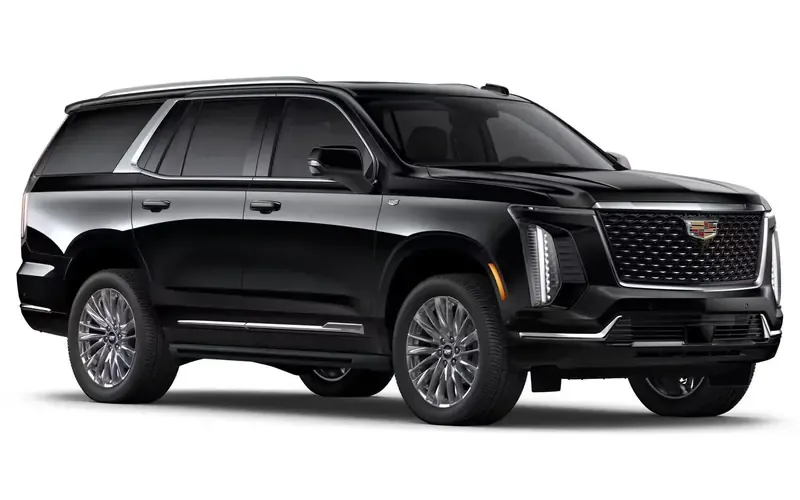
A Sprinter limo van seats up to 10–14 guests with standing room and a tall door, which helps anyone in a full gown or a long veil. For parents, grandparents and VIP guests, a luxury sedan or SUV seats up to 3–6 in comfort and drops them closer to the door.
Guests who are not in the wedding party
Guest shuttles are a separate job from the wedding party cars. A shuttle bus or mini coach seats up to 25–56 guests and runs between hotel and venue on a loop. Plan the hotel to venue shuttle around check-in times and the ceremony start, not around the couple's schedule.
When you need more than one vehicle
Most church-to-reception days use two or three vehicles: the couple, the bridal party and the guest shuttle. A multi-vehicle wedding plan is written as one schedule so the cars do not arrive at the same corner at the same moment. Each vehicle has its own chauffeur and its own copy of the run sheet.
Cars outside the fleet list
Rolls-Royce, Bentley, vintage, classic and electric cars are not in our fleet list. If you have your heart set on one, availability is confirmed on request and written on the quote like everything else. Build the rest of the plan so the day still works if that car cannot be sourced.
The getaway car
The car that takes you from the reception is booked separately from the ceremony cars and often runs much later. A getaway car should be confirmed with its own pickup time and location, especially if the reception ends after dark. Do not assume the morning car will still be there.
Photo Stops That Fit Between Church and Reception
A photo stop is a timed stop, not a detour. Choose one or two places that sit naturally on the route between the church and the reception, then check the light, the parking and the walk from the curb. The DC wedding day traffic guide is worth reading before you fix the order of stops.
- Light first. Check where the sun will be at your stop time. A location that photographs beautifully at noon may be in shade by late afternoon, and the photographer will know which side of a building works.
- Route, not reputation. A famous landmark across the city adds a crossing of the Potomac or the Anacostia in each direction. Pick stops between the church and the reception rather than pulling the day out of shape.
- Parking for the vehicles. The cars need somewhere legal to wait while you shoot. Confirm with the photographer or planner where the vehicles will stand, and keep the stop short enough that a waiting car is not a problem.
- The walk from the curb. A stop that looks close on a map can be a long walk in heels or a climb up steps. Walk it in your head, or better, in person, before you commit to it.
- One stop, done well. Two short stops often produce less than one good one. Give the photographer a realistic block at a single location and let the pictures breathe.
- Weather backup. Have an indoor or covered alternative for each outdoor stop. A weather backup plan keeps the schedule intact when the forecast turns.
- Guests and the gap. If guests are traveling between church and reception, the photo stop is their gap too. Make sure the shuttle timing and the photo timing are written as one plan, not two.
- A private moment. Some couples use the car itself for a first look or a few quiet minutes before the crowd. A first look using the wedding car can replace a stop entirely.
Parking, Loading and the Ten Minutes Nobody Plans For
The last hundred yards of any leg take the longest. A church on a narrow street, a reception venue with one loading zone and a line of cars all wanting the same curb will eat time no matter how well the driving went. Build ten minutes into every arrival for the part where people get out, gather their things and walk in.
At a church, the front steps are the bottleneck. The couple usually wants a moment on the steps, the wedding party wants to arrange itself and guests are still arriving or leaving. Ask the church office in advance where vehicles may stop and how long they may wait, and treat that answer as fixed. Rules vary by building, so confirm with the church directly rather than assuming.
Reception venues have their own constraints. Hotels in downtown DC, event spaces around Capitol Hill and venues in Old Town Alexandria often have a single drop-off point shared with other events. Ask the venue for the loading zone, the time window and whether the vehicle can wait or must circle. A chauffeur who knows the plan can drop and move on rather than blocking the entrance.
One Run Sheet, One Contact, One Plan for the Day
Every wedding we handle gets one written run sheet, shared with the couple or their planner. It lists each vehicle, each pickup and drop-off, the times, the named contact for each stop and any touches booked for the day. The chauffeur works from that sheet and stays in touch with the planner or a named contact as the day moves.
The named contact matters as much as the sheet. On the day, one person should be reachable and able to make a call about a late photo stop or a change of order. If that person is the bride, the plan will not work. Choose a planner, a family member or a member of the wedding party who is not in the photographs.
Write down the details that are easy to forget: red carpet, Just Married signs and other touches are arranged when booked and appear on the quote, never assumed. Alcohol rules for the vehicle are also on the quote and depend on the vehicle and on DC, Virginia or Maryland law, so read them before the day. When you are ready to build the schedule, request a free wedding quote and we will write it out, itemized, before anything is booked.
If the ceremony is at a church, start with our church wedding transportation page for the questions to ask the church office. Then bring the answers to the quote and let the run sheet carry the day.